Showing posts with label Extreme environment. Show all posts

Thursday, 3 November 2011

Resurrection plants

from How Plants Work.com :

One of the main problems for plants when they colonized terrestrial environments on Earth nearly a half billion years ago was how to survive the dryness.

Resurrection plants, however, display the remarkable ability to survive near total desiccation (less than 5% relative water content), which causes them to appear dead. But when rehydrated, these plants can be revived. Hence, they are often referred to as “resurrection plants”.

Probably the most well-known is the species Selaginella lepidophylla


Briefly, the onset of water loss apparently sets into motion a series of cellular events that can be summarized as follows:

Dehydration –> Activation of “desiccation-related” genes –> (1) Alterations in metabolism and (2) Production of “protective” proteins

(1) Alterations in metabolism: (a) accumulation of protective solutes such as sucrose, trehalose, and proline that stabilize proteins and cellular membranes, (b) production of antioxidant compounds (such as galloylquinic acids), and (c) biochemical alterations in membrane and cell wall composition.

(2) Production of “protective” proteins such as “dehydrins” and “expansins” that help preserve the structural integrity of intracellular organelles and the cell walls.

References
1. Moore, J.P., et al. (2006) “Response of the Leaf Cell Wall to Desiccation in the Resurrection Plant Myrothamnus flabellifolius.” Plant Physiology Vol. 141, pp. 651–662.
2. Layton, B.E., et al. (2010) “Dehydration-induced expression of a 31-kDa dehydrin in Polypodium polypodioides (Polypodiaceae) may enable large, reversible deformation of cell walls.” American Journal of Botany Vol. 97, pp. 535-544.
3. Moore, J.P., et al. (2009) “Towards a systems-based understanding of plant desiccation tolerance.” Trends in Plant Science Vol. 14, pp. 110-117.

And this amazing plants are at the basis of a long-term thermostabilization process to preserve vaccines,
here some more details:
http://www.thenakedscientists.com/HTML/content/interviews/interview/1281/
http://stm.sciencemag.org/content/2/19/19ra12.abstract
http://www.dailymail.co.uk/health/article-322568/Vaccine-breakthrough-revolutionise-Third-World-health.html
http://www.ncbi.nlm.nih.gov/pubmed/17661683

Thursday, 22 September 2011

Dutch PlantLab Revolutionizes Farming


Soilless coltivation, LEDs, highly controlled environmental conditions, advanced sensors...they call it agricolture 3.0!  In short, they create a high tech paradise for plants...
Will the quality decrease? who knows, but the possibility to grow plants undergroung or at the top of skyscrapers is fascinating! Urban agriculture isn’t new, and people have been talking about vertical farms for decades.What makes PlantLab different is the hardcore scientific and mathematical innovation they are bringing to the table! Could we grow vegetables in space using this amazing facility?!


http://www.plantlab.nl/4.0/

Friday, 6 May 2011

Dance of the Dumbo Octopus

This footage of a Dumbo octopus was captured 6600 deep off the coast of Oregon, cool video taken from The Science News Blog

Friday, 29 April 2011

The Lake Vostok

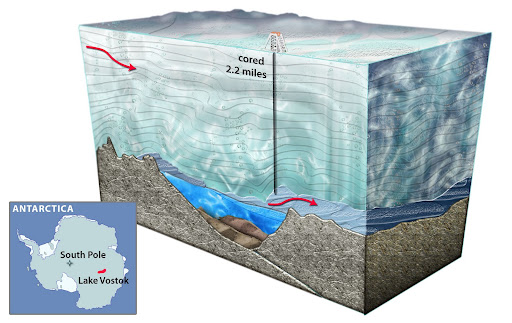
Lake Vostok is the largest lakes found under the surface of Antarctica. 
The lake is located beneath Russia's Vostok Station, 4,000 metres under the surface of the ice sheet. Lake Vostok covers an area of 15,690 square kilometres and thanks to the similarities to other lakes (Ontario in America and Lake Malawi in Africa) geologist could guess the period of its formation: about 65 million years ago, when Antarctica still had a tropical to subtropical climate. 
Scientists found that the lake under the ice is not froze, and the temperature could vary between 18 C to -4 C, so life could still be there!!
Russians stopped to drill in January 2011 to avoid possible contaminations, and now scientific community is try to define a way to:
- Go down the 4000m of ice (without drilling)
- Sample the water avoiding the contamination of the water
It is very easy to guess that the space agencies are extremely interested in this unique place on Earth, because if they will be able to find some living organisms they might be evolved separately from the rest of the world for 65 million years! 
I really suggest you to watch  this documentary if you haven't seen it yet: